

“A fiberglass stake that breaks in 3 years is a liability; a stake that lasts 20 years is an asset.”
In the competitive world of commercial arboriculture and large-scale nurseries, the longevity of support structures directly impacts the bottom line. As we move into 2026, the focus has shifted from “temporary support” to “long-term infrastructure.” This article dives deep into the manufacturing secrets of fibreglass tree stakes, specifically how high-tech UV-resistant coatings and advanced pultrusion techniques achieve an unprecedented 20+ year outdoor life.
1. The Manufacturing Core: The Pultrusion Process
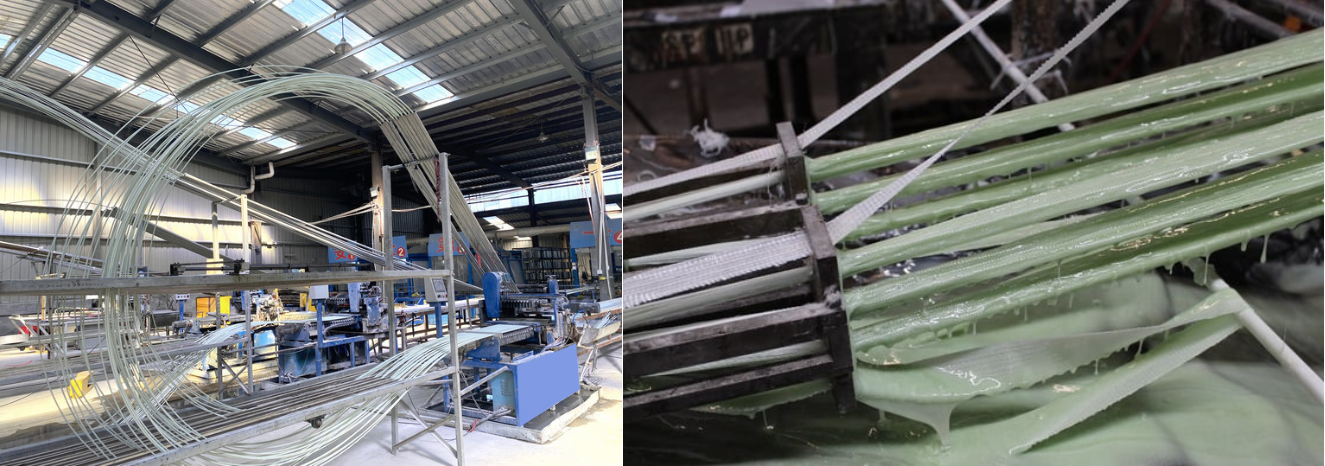
To understand why a fibreglass stake lasts decades, we must look at how it is born. Unlike injection-molded plastics, professional-grade stakes are created through Pultrusion.
The Anatomy of Strength
The pultrusion process involves pulling continuous glass fibers through a heated resin bath and a precision-shaped die. This creates a profile with an extremely high glass-to-resin ratio (typically 70% glass to 30% resin).
Linear Reinforcement: The fibers run longitudinally, giving the fiberglass stake its incredible flexural strength.
Consistency: Every millimeter of the stake has the same structural density, ensuring no “weak spots” where snapping might occur.
Technical Note: The modulus of elasticity (E) in our manufacturing process is calibrated to ensure the stake provides enough “give” for the tree to build wind-resistance wood, while maintaining a tensile strength of over 400textMPa.
2. The UV-Resistance Breakthrough: Solving “Fiber Blooming”
The biggest enemy of outdoor composites is the sun’s Ultraviolet (UV) radiation. Without proper treatment, standard fiberglass will suffer from “fiber blooming”—a process where the resin degrades, exposing itchy glass fibers to the surface.
How CQDJ Ensures 20+ Years of Life
Our manufacturing line incorporates a multi-stage UV protection strategy:
UV-Stabilized Resin Matrix: We infuse the base polyester or epoxy resin with high-grade UV inhibitors (HALS – Hindered Amine Light Stabilizers). These additives absorb UV energy and dissipate it as harmless heat.
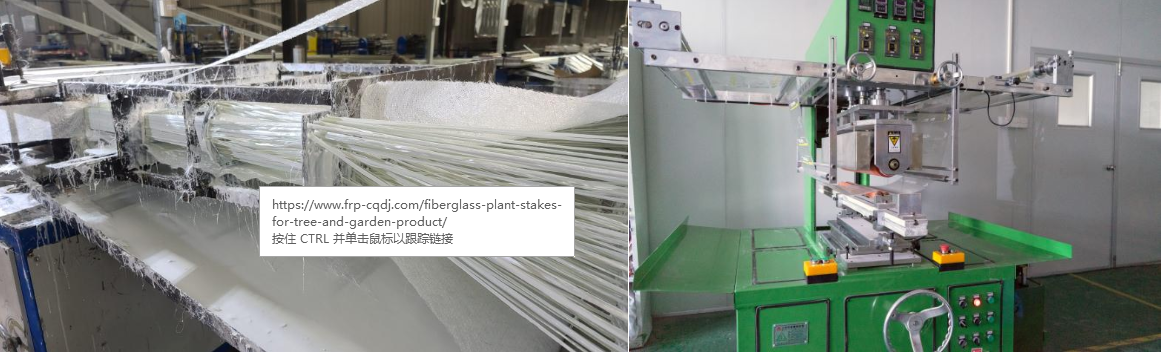
The Polyester Surface Veil: This is the “secret sauce.” During pultrusion, a fine polyester veil is wrapped around the fiber core. This creates a resin-rich surface layer that acts as a sacrificial shield, protecting the structural fibers from direct sun exposure.
Specialized Exterior Coating: For extreme environments (such as high-altitude orchards or tropical regions), we apply an additional UV-resistant topcoat that provides a secondary barrier against hydrolysis and photo-oxidation.
3. Performance Specs: Fiberglass vs. The Alternatives
For a procurement manager, the data speaks louder than words. Let’s compare the degradation of various materials over a 20-year horizon.
|
Material |
Initial Cost |
Est. Lifespan |
UV Resistance |
Maintenance |
20-Year ROI |
| CQDJ Fibreglass | Medium |
20-25 Years |
Excellent | Zero | High |
| Treated Pine | Low |
5-7 Years |
Poor (Rot) | High | Low |
| Natural Bamboo | Very Low |
1-2 Years |
Poor (Brittle) | Constant | Negative |
| Galvanized Steel | High |
10-15 Years |
N/A (Rust) | Medium | Medium |
4. Customization for Industrial Needs
Manufacturing isn’t just about the material; it’s about the application. At CQDJ, our production lines allow for granular customization:
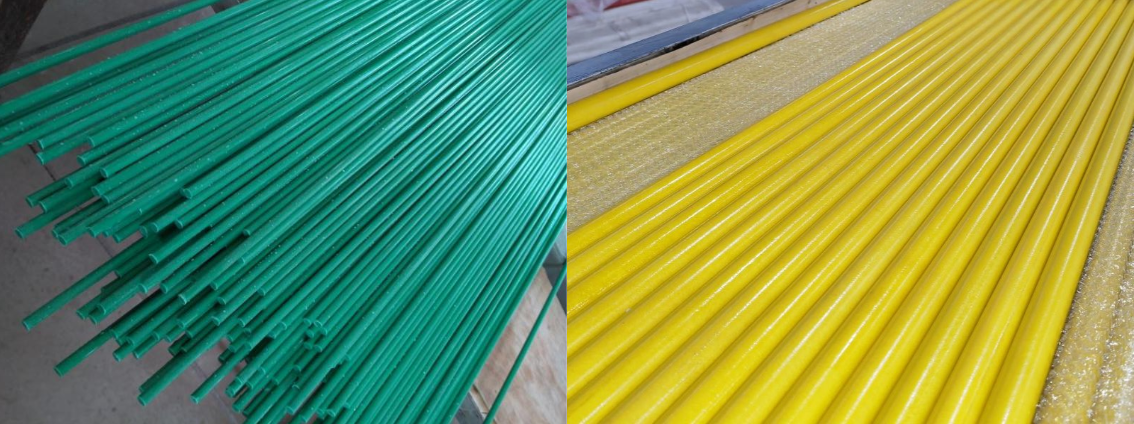
Diameter Range: From 1/4″ (6mm) for delicate nursery liners to 3/4″ (19 mm) for heavy-duty commercial orchard trellis systems.
Surface Texture: Choose between a smooth finish for easy handling or a ribbed surface for better grip with tree ties and clips.
Pointed Ends: Precision-tapered ends are standard to ensure low-effort installation in hard-packed soils.
5. Case Study: 20 Years in the Field
In a recent assessment of stakes installed in a high-exposure vineyard in 2006, our UV-resistant fibreglass stakes showed less than 5% loss in flexural strength. The surface remained smooth to the touch, with no signs of the fiber-blooming that plagues inferior products.
This long-term stability is why our manufacturing facility in Chongqing (CQDJ) has become a trusted partner for global export, supplying thousands of tons annually to the USA, Europe, and Russia.
6. Sourcing Intelligence: What to Ask Your Manufacturer
If you are sourcing bulk fibreglass stakes, don’t just ask for the price. Ask these technical questions to verify quality:
- What type of UV stabilizer is used in your resin?” (Look for HALS-type stabilizers).
- Does the stake include a surface veil?” (Essential for skin safety and UV life).
- What is the glass-to-resin ratio?” (Higher glass content equals higher strength).
- Can you provide a COA (Certificate of Analysis) for tensile strength?”
7. Logistics and Scalability: The CQDJ Advantage
When you partner with a manufacturer, you need to know they can handle the volume.
Capacity: Our facility operates multiple pultrusion lines 24/7.
Loading Efficiency: We specialize in maximizing container space. For an 8ft stake, a 20GP container can typically fit 17 tons, ensuring your landed cost per unit is as low as possible.
Export Ready: All our products are packaged in UV-protected bundles to ensure they arrive at your port in factory-fresh condition.
Conclusion: Quality is a Choice
The manufacturing of fibreglass tree stakes is a precise science. By investing in UV-resistant technology and high-quality pultrusion, you aren’t just buying a support stake—you are investing in the long-term health of your orchard and the efficiency of your operations.
At Chongqing Dujiang Composites (CQDJ), we stand by our 20+ year outdoor life guarantee. We invite you to test our samples against any other product on the market.
FAQ (Frequently Asked Questions)
Q: Why does fiberglass get itchy, and how do you prevent it?
A: Itchiness is caused by “fiber blooming” when UV rays break down the resin. Our specialized UV-resistant coating and surface veil keep the fibers encapsulated, making them safe to handle for decades.
Q: Are these stakes suitable for organic farming?
A: Yes. Unlike chemically treated wood (CCA), our fibreglass stakes are inert and do not leach toxins into the soil, making them perfect for organic-certified orchards.
Q: What colors are available?
A: While forest green and white are most popular for nurseries, we can manufacture custom colors like safety orange for visibility in snow or high-traffic areas.
Post time: Mar-23-2026


