

What Is Biaxial Fiberglass Cloth, and Why Does It Show Up in Every Boat Hull and Wind Blade Spec Sheet?
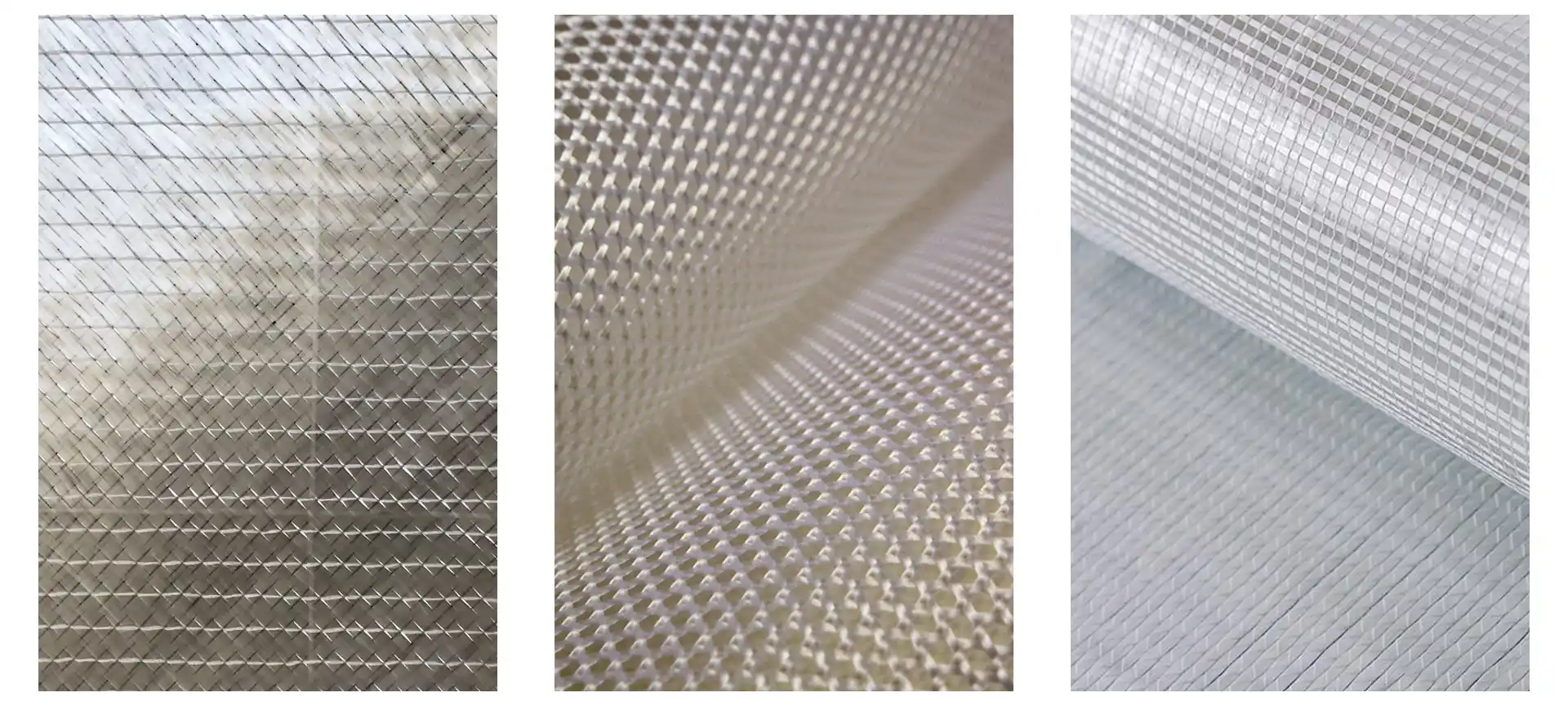
Biaxial fiberglass cloth gets specified constantly in marine and wind energy work, but a lot of people ordering it couldn’t tell you exactly why it beats woven roving for the job—just that it’s what the spec sheet calls for. The answer comes down to how the fibers are held together, and that one detail changes almost everything about how the fabric performs under load.
Here’s what’s actually going on with biaxial cloth, how it stacks up against woven roving and mat, and why 1708 specifically became the workhorse weight in so many shops.
The Basic Idea
Biaxial fiberglass cloth is made from two layers of glass fiber strands laid at angles to each other—almost always +45° and -45°—and stitched together rather than woven. That stitching detail is the whole story, really. In a woven fabric, the strands go over and under one another, which means every strand has a slight wave built into it. Under load, that wave wants to straighten out before the fiber does any real work, and that costs you strength.
Stitch the layers instead of weaving them, and the strands stay dead straight. The load hits the fiber directly instead of pulling out a crimp first. That’s why, weight for weight, biaxial cloth generally outperforms woven roving on strength.
A lot of biaxial fabric on the market also comes with a thin layer of chopped strand mat stitched to one face. You’ll see this sold under names like 1708, where the “17″ is the biaxial weight and the “08″ is the mat weight, both in ounces per square yard. It’s a combo product, basically—you get directional strength and a mat layer for resin fill in one pass, instead of laying two separate fabrics.
Not the Same as Woven Roving (and Definitely Not Mat)
People use these terms loosely, so it’s worth being precise.
Woven roving is interlaced, 0°/90°, and cheaper—but crimped, which limits its strength ceiling and leaves a coarser, more textured surface once it’s laminated.
Chopped strand mat has no real fiber direction at all. It’s randomly oriented short strands held with a binder, mainly there to bulk up a laminate and help resin flow, not to carry structural load.
Unidirectional fabric goes the other way entirely—almost all the fiber runs in one direction, which is exactly what you want for something like a spar cap that only sees load along its length.
Biaxial sits in between, and that’s the point of it. When a structure has to resist twisting or flexing from multiple angles—a boat hull taking wave impact, a turbine blade under constant cyclic bending—a ±45° layup handles that far better than a 0°/90° weave does.
| Fabric | Fiber direction | What it’s good at | Typical use |
|---|---|---|---|
| Biaxial | ±45°, stitched | Shear and torsional loads | Hulls, blade skins, structural panels |
| Woven roving | 0°/90°, interlaced | General strength, budget builds | Basic laminating |
| Unidirectional | Single axis | Maximum strength one way | Spar caps, beams |
| Chopped strand mat | Random | Resin fill, bulk | Backing layers, surface prep |
| Triaxial / quadraxial | 3-4 directions | Complex, multi-directional loading | Heavy structural laminates |
Where the “1708″ Number Actually Comes From
This trips people up more than it should. Fiberglass rolls are labeled by areal weight—ounces per square yard, or gsm if you’re working from a metric spec sheet. The 1708 biaxial fiberglass roll gets its name from combining roughly 17 oz/yd² of ±45° biaxial fiberglass with about 0.75 oz/yd² of chopped strand mat stitched to the back.
Why has this particular combination stuck around? Mostly because it hits a sweet spot for hand layup and infusion work—enough structural fiber to matter, plus a mat layer that fills surface irregularities and helps wet-out, without needing two separate fabric applications. You’ll also come across 1808, 1701, and various GSM-labeled equivalents; the naming convention shifts depending on where the fabric was made, but the logic behind the numbers is the same.
Where It Actually Gets Used
Marine builders reach for biaxial cloth constantly, particularly for hull and deck laminates, because a hull moving through water is essentially being twisted and flexed from every direction at once. A 0°/90° weave just doesn’t handle that as gracefully.
Wind energy is probably the biggest volume user of 1708 specifically. Blade skins go through millions of load cycles over a 20-year service life, and non-crimp fabric holds up to that fatigue better than woven alternatives—the straight fibers don’t have a built-in crimp point to crack over time.
You’ll also find it in FRP tanks and piping, where hoop and axial strength both matter; in automotive composite panels, where the strength-to-weight advantage over woven roving actually shows up on a scale; and in structural repair work, where biaxial glass fabric gets wrapped around concrete, timber, or masonry as part of a reinforcement system.
Why Shops Keep Choosing It Over Alternatives
A few practical reasons come up again and again in fabrication:
Less print-through on the finished surface, since there’s no over-under crimp pattern telegraphing through the laminate.
Better compatibility with vacuum infusion, because the open stitch pattern lets resin travel through the fabric more evenly than a tight weave allows.
Fewer total layers are needed when you’re using a combo fabric like 1708, which saves real labor hours on a big layup schedule.
And better fatigue life, which is the whole reason it dominates blade manufacturing—cyclic loading is brutal on crimped fiber in a way it isn’t on straight fiber.
Picking the Right Spec
 A few questions worth answering before you order a roll:
What direction is the load actually coming from? If it’s genuinely one axis, unidirectional will outperform biaxial for less material. If it’s multidirectional or you’re not sure, ±45° biaxial is the safer default.
What’s your fabrication method? Hand layup, vacuum infusion, and RTM all drape and wet out differently, and not every biaxial weight infuses cleanly.
Does a combo fabric make sense for your layup schedule? If you’re laying mat and biaxial separately anyway, something like 1708 might cut a step out of your process.
And don’t overlook roll width — 50″, 60″, and 72″ are the common stock widths, and matching that to your mold geometry ahead of time saves a surprising amount of scrap.
Sourcing 1708 biaxial fiberglass rolls or other weights for an upcoming build? We stock standard widths and can cut custom specs for larger orders—get in touch for current pricing and lead times.
Post time: Jul-16-2026


