

What a Flexible Fiberglass Rod Will and Won’t Do
Chongqing, 22 September 2026.
I’ve been in this trade since 1989. Chongqing Dujiang built itself on chopped strand mat and woven roving, and that is still most of what leaves our gate. Rod came late. It came because customers wouldn’t stop asking. A guy in Ontario buys our 2400 tex roving for his own pultrusion line, then calls eight months later wanting us to just ship him the finished stick. Enough of those calls and you buy a die.
So we did. CQDJ now runs flexible fiberglass rod in round and square, quarter-inch through one-inch, standard 10 ft lengths or cut to whatever your carton allows. I’m writing this because the same four questions land in my inbox every week, and I’d rather answer them once where everybody can read it.
A flexible fiberglass rod is a stiffness spec, not a softness spec
This is where buyers get burned. Flexible does not mean squishy. It means the rod takes a deep bend and comes back straight, over and over, without taking a set or cracking the resin. Every solid rod is stiff for its diameter. What you’re buying is elastic strain to failure, and E-glass carries roughly 4 percent of it where steel manages about 0.2. That ratio is the entire product.
Folks also call them bendable fiberglass rods. Bendable is the wrong word. Bendable suggests it stays where you put it. Buy a flexible fiberglass rod off the wrong line, and that is exactly what you get—a stick that holds a kink after one season stuffed in a bag.
Here’s the scale. A 1/2-inch rod will bend to a fist-sized radius. A 3/4 in fiberglass rod bends to roughly a basketball. A 1 inch fiberglass rod barely bows under body weight, and if you lean on it, you will hear the resin start to talk. None of those are soft. They store energy and hand it back.
A tent maker in Zhejiang told me his old supplier’s pole came out of storage with a permanent bow. That’s a resin problem, not a fiber problem. Under-cured polyester creeps. Ours runs at a line speed that puts the exotherm in the middle of the die, and we check Barcol before anything gets cut to length.
Round, square, and the tooling bill nobody quotes you
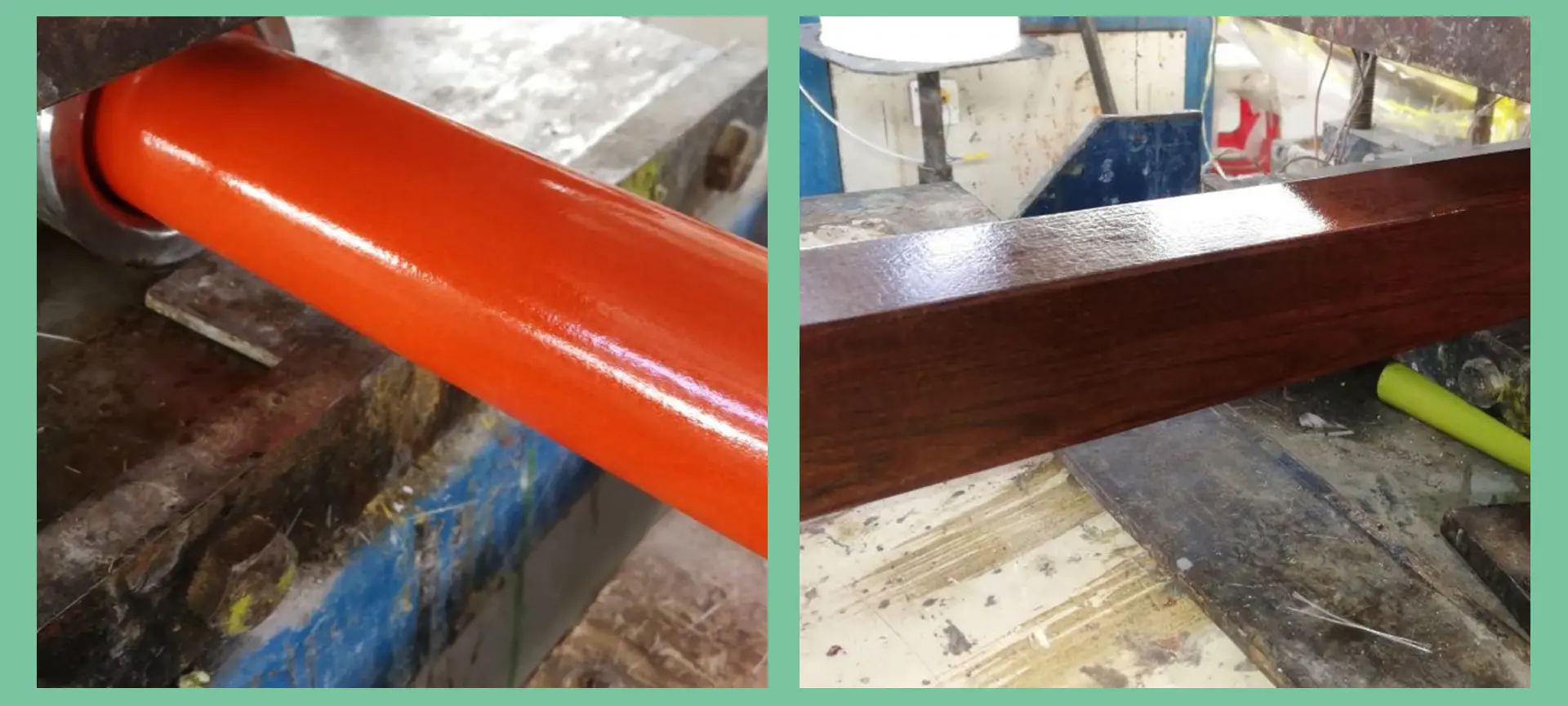
Ninety percent of what we pull is fiberglass round rod. Round tools are cheap, pull fast, and fit the hardware you already own—ferrules, end caps, spring-button joints, and clamps. Round is what most of you actually need.
Square is a different animal. A square fiberglass rod gets specified when something has to be clamped, screwed, or kept from spinning in a bracket. Flat faces bite, so if you need a flexible fiberglass rod that clamps without spinning, square is the answer, and the die is the price. The catch is the die. A round die is a drilled steel block. A square die has corners; corners wear, and worn corners show up as rounded edges and a fuzzy surface on the last thousand meters of a run. We price square accordingly, and we tell you up front when the die is due for rework. Nobody enjoys that conversation in week six.
Half inch, five eighths, three-quarters, one inch
Orders cluster hard around four sizes. The most flexible fiberglass rod people ask for most is the half inch. 1/2 in fiberglass rods are the workhorse—kite spars, greenhouse hoops, plant support, and light marker posts. About 240 grams per meter, so a ten-foot stick sits in your hand at roughly 730 grams.
5/8 fiberglass rod is the step up once the half-inch bows too much. 15.9 mm. Driveway markers, electric fence posts, ribs on a small awning. Bending stiffness runs with the fourth power of diameter, so 15.9 against 12.7 gives you close to double the stiffness for maybe 50 percent more weight. That arithmetic is why the half-inch crowd moves up instead of buying a thicker wall.
3/4 in fiberglass rod is 19 mm, and it’s where the rod stops being a spar and starts being a post. Sign stakes, heavy hoops, and uprights on a row-cover tunnel. Around 540 grams per meter. A ten-foot length is 1.6 kg, and it will hurt if you drop it on your foot.
One inch is the ceiling for most of what we do. At 25.4 mm, you’re near a kilo per meter. Past that, sane buyers move to tube and never look back.
Ten feet is where your freight quote falls over
The standard mill length on solid fiberglass rods is 10 ft. A 10 ft fiberglass rod is 3.05 meters of one-piece stick, and 3.05 meters does not go in a normal carton. Carriers stamp it oversize and bill accordingly. I have watched a customer pay more to ship forty straight lengths than he paid for the rods themselves.
Two ways out. Cut to length—anything at or under 1.5 m drops into standard parcel lanes, and the per-piece rate collapses. Or drop the diameter and ship coiled. Quarter inch and 3/16 will coil into a 600 mm loop all day long. A coiled, flexible fiberglass rod in 1/2 inch will take a very large loop if you don’t mind the memory. Solid fiberglass pole stock at 3/4 and up does not coil. Don’t ask.
If you genuinely need a 10 foot fiberglass rod in one piece, put it in the RFQ. We’ll pack it in a rigid tube and quote the freight honestly up front instead of surprising you after payment.
What the die actually decides
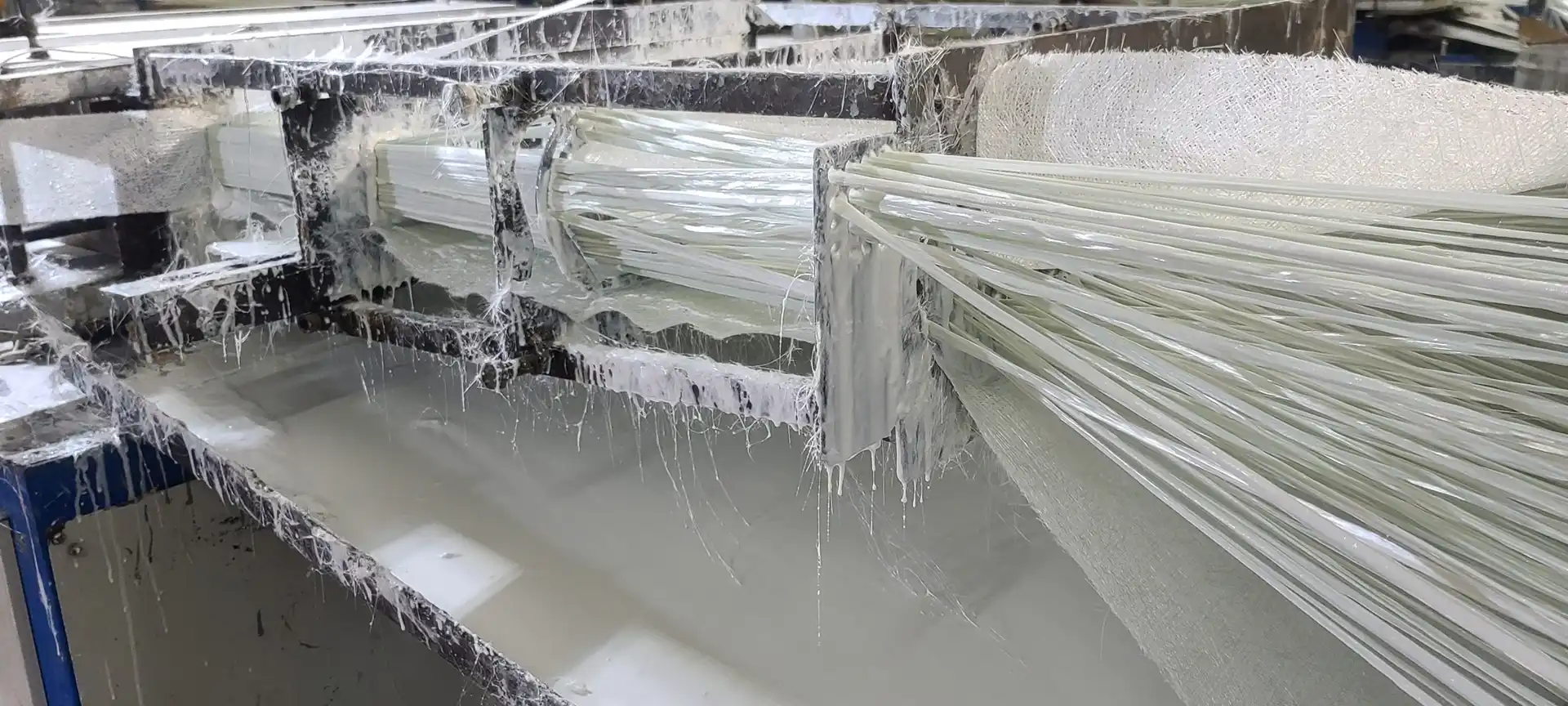
A pultruded fiberglass rod is continuous roving dragged through a resin bath, gathered, and pulled through a heated steel die. Fiber volume lands around 65 to 70 percent. That number is the product. Fall to 50, and you’ve made something that photographs identically and behaves like a different material by February.
The cheap rod floating around the market is calcium carbonate filled. You can spot it in ten seconds. Sand the cut end. A good rod gives a tight, glassy face with the fibers held flat. Filled rod dusts white, and the surface chalks before you finish sanding. Or weigh a known length, burn the resin off at 600°C, and weigh what’s left. Under 60 percent residue and you’ve been sold filler.
We run E-glass in an isophthalic polyester matrix as standard, with a polyester surfacing veil over the top. Vinyl ester is available when the rod lives in water or in a chemical splash zone, and it costs real money. I will talk you out of it for a tomato stake and insist on it for a tank farm marker.
What people type into the RFQ box
Half my inbox is a subject line with no spaces and no punctuation. 1 2 fiberglass rod. 3 4 fiberglass rod 10ft. One wants a half-inch stick, the other wants 19 mm at three meters, and both typed it in a single breath at eleven at night. Doesn’t bother me. What bothers me is the other half, where “fiberglass rods” arrives with no diameter, no length, no quantity, and no application. That one sits in the queue until you tell me what it’s for.
And yes — fiber glass rods, fibreglass rod, fibreglass, and glass fiber. All of it lands in my search box, and all of it is the same product. Spell it how you like.
Chalking and splintering, the two failures I keep seeing
Failure one is UV. Polyester rod with no veil and no UV package chalks in about eighteen months outdoors. The surface goes white, the resin recedes, and glass blooms through the skin. It holds load for a while after that, and then one winter it doesn’t. A customer in Alberta set six hundred cheap markers along a fence line in 2011. By the third winter, he was replacing them in batches. Our standard build carries a surfacing veil plus a UV absorber. If you want five years plus in full sun, ask for the coated version and pay the extra cents a meter.
Failure two is the cut end. Solid fiberglass rod splinters when it fails in bending, and the ends are where failure starts. Bare-cut fibers wick water. Water plus freeze-thaw plus load opens the bundle, and the rod unzips from the end inward. Seal them. A dab of resin, a heat-shrink cap, a ferrule. Two minutes a stick and you’ve roughly doubled the service life. A flexible fiberglass rod left with raw ends in a wet climate is a rod with a short life, no matter how good the pull was.
One more thing. When a rod lets go, it lets go with a bang and a spray of glass slivers. Wear eye protection. I’ve picked splinters out of a man’s forearm, and it is not a pleasant afternoon.
Send us this, and we’ll quote the same day.
Diameter, length, quantity, and what the thing has to do. Round or square. Indoors or full sun. Whether it has to be non-conductive—antenna and HV work is a real segment for us; E-glass is dielectric, and that is often the whole reason anybody buys it. And whether it sees water.
We hold 1/2, 5/8, and 3/4 rounds in Chongqing most of the year. 1/2 fiberglass rods and 5/8 ship within a week. Square, and anything above 3/4, runs to schedule—three weeks typical, plus die time if it’s a size we don’t stock.
Flexible fiberglass rods are not a mystery product. They’re roving, resin, and a hot die, and the gap between a good one and a bad one is whether the man running the line respects the cure. We’ve been at this a long time. Send the RFQ.
Post time: Sep-22-2026


