


Inquiry for Pricelist
For inquiries about our products or pricelist, please leave your email to us and we will be in touch within 24 hours.
CLICK TO SUBMIT AN INQUIRY


Start with the fiber, because this is not a better grade of E-glass. It is a different material with a different process behind it. We draw continuous filament from a fused quartz rod in an oxy-hydrogen flame, chop it into staples, card the staples into a loose web, and then punch barbed needles through the web thousands of times. Friction between the filaments holds the whole structure together. No binder, no yarn, nothing organic anywhere in the roll.
High silica takes the other road. It is made by leaching boron and alkali out of ordinary E-glass, so you land above 96% SiO₂ plus whatever refused to leave. Quartz skips that route. Purity sits above 99.9%, and since the fiber was never acid-treated, it keeps a clean surface with no micro-cracks etched into it. That surface is where the strength advantage comes from, not the chemistry alone.
The first is headroom. Quartz fiber needle felt holds 1050C continuously and takes short excursions past 1200C without slumping or delaminating. The softening point sits up near 1700°C, so there is a real gap between the service rating and the point where it stops being solid. That gap is the product. You are not paying for it to sit at 1050C forever. You are paying for the days it goes higher.
The second is dielectric. Dielectric constant 3.74, loss tangent 0.0002, and it holds those numbers at temperature. Nothing else in this price class comes close. If your part has to let a radar or a radio signal through while it is being cooked, quartz fiber needle felt is not the premium option. It is the only serious option.
Only one of those two reasons justifies the price tag. Most of the inquiries I get are chasing the first one.
I talk more customers out of quartz than into it, and I intend to keep it that way. Below roughly 1000C, high silica does the work at a fraction of the cost. If your line sits at 800℃ and you buy quartz fiber needle felt because it feels safer, you have paid several times over for headroom you will never touch.
A tempering furnace rebuilder sent me a drawing not long ago and asked for quartz fiber needle felt across the entire hot section. Fair request on paper. I asked what the thermocouples read on a bad day. 760℃. We quoted high silica for the wall insulation instead, and he put the difference into thermal breaks on the second furnace. He did come back for quartz, but only for the transfer zone, which is the part that genuinely runs hot.
The second mistake is more expensive. It is buying quartz fiber needle felt for a long soak at a temperature it cannot take for a long soak. Read the next section before you write the purchase order.
Quartz fiber is amorphous glass. Sit it hot long enough and it starts to crystallize. Cristobalite grows inside the filament, the filament embrittles, and the strength you paid for leaves quietly. Suppliers print 1200C on the datasheet and stop talking there.
Devitrification is a function of temperature and time together. A mat that touches 1150℃ for ten minutes a week is doing a completely different job from a mat that holds 1150C for two years straight. Give me both numbers, and I will tell you straight whether the quartz fiber needle felt survives your shift pattern or whether the honest answer is a rigid hot face with felt behind it doing the work in the cooler zone.
That is why I never quote off a temperature rating alone. It is also the reason a competitor will happily quote you quartz, whereas I will not.
Semiconductor thermal processing is the biggest honest volume for me. Diffusion furnace insulation, hot zone lining, and the quartz fiber needle felt that sit between the heating elements and the chamber wall. The specification that matters there is not temperature. It is cleanliness. Quartz carries almost no sodium, iron, or copper, so nothing migrates out of the insulation and onto a wafer during a long run.
A hot zone assembler I supply tests every incoming batch for leachable ions before it goes anywhere near a chamber. With quartz fiber needle felt that test is a formality. With alumina or ordinary ceramic fiber, it turns into an argument about the batch. That is not a marketing point; it is a scrap rate.
Optical fiber drawing runs on the same logic. High purity, no outgassing, and nothing shedding particulate into a process measured in microns. Furnace builders in that trade do not shop for quartz fiber needle felt on price. They choose it on what it does not release.
Aerospace buyers arrive for the dielectric number. Radomes, antenna windows, and missile and drone airframes. Quartz fiber needle felt shows up as an insulating layer behind a structural skin and as a needled preform that gets impregnated afterwards because the punched structure wets out evenly. Those two uses look nothing alike on a drawing and land on the same page.
Then there is the long tail. Hot acid gas filtration, where quartz shrugs off everything except hydrofluoric acid and hot phosphoric acid. Induction coil liners. Expansion joint packing on a kiln that ate three other materials first. Quartz fiber needle felt gets specified in all of them, usually after something else failed loudly.
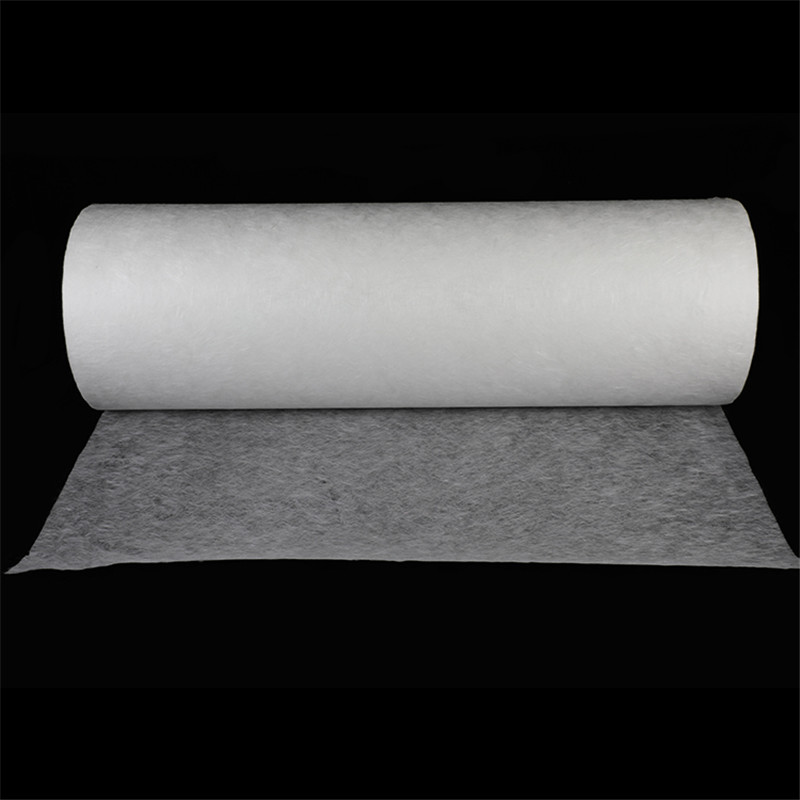
This is the range we run. Thickness and service temperature are the two numbers I need before I can put a price on anything. The quartz fiber needle felt below is the standard grade, unbleached and binder-free.
Typical Specifications—quartz fiber needle felt, 1200℃ grade
| Specification | Value |
|---|---|
| Base fiber | Fused quartz, SiO₂ ≥99.9% |
| Filament diameter | 4–9 µm |
| Continuous temperature | 1050°C (1922°F) |
| Short-term peak | 1200°C (2192°F) continuous; up to 1400°C (2552°F) short-term peak |
| Softening point | 1700°C |
| Binder | None — 100% mechanical needling |
| Thickness | 3–20 mm |
| Density | 100–280 kg/m³ |
| Area weight | 200–1000 g/m² (±10%) |
| Max roll width | up to 1000 mm (Customizable up to 3000 mm) |
| Roll length | 50–100 m (or customizable) |
| Porosity | above 90% |
| Dielectric constant | 3.74 at 1 MHz |
| Loss tangent | 0.0002 |
| Coefficient of thermal expansion | 0.54 × 10⁻⁶ /K |
| Compressibility / rebound | 30–50% compressed, above 90% rebound after unloading |
| Chemical resistance | Most acids and weak alkalis; attacked by hydrofluoric acid and hot phosphoric acid |
| Leachable ions | Na ≤ 5 ppm, Fe ≤ 5 ppm, Cu ≤ 1 ppm (or as per your COA) |
| Colour | White |
| Flammability | Non-combustible |
| Typical applications | Semiconductor hot zone lining, optical fiber furnace insulation, radome and antenna layers, ablation backing, glass tempering furnace insulation, hot acid gas filtration |
| Packaging | Vacuum foil barrier bag in carton (standard export packaging) |
| MOQ | 20m |
Every figure above is measured on shipped goods, not on a lab coupon pulled on a good day. If your inspector works to a named method, tell me which one before we quote, and we will run it that way rather than to ours.
Continuous temperature, peak temperature, and how long the peak lasts. Those three sentences decide more than everything else on this page. Then thickness, whether the felt sits loose or gets compressed into a gap, and rough quantity.
Add one more line if your part has to be transparent to a signal. Tell me the frequency band, and I will send the dielectric data rather than a price, because that is the enquiry where the wrong grade costs you a redesign.
Our plant runs to ISO 9001:2015, and we quote thermal conductivity tested to ASTM C518 where a project calls for it. Ask for the certificate and the test sheet with the quote.
If you are not sure which rung of the ladder you belong on, send the temperature and let me say it. Plenty of the quartz fiber needle felt inquiries I answer end with me selling high silica fiberglass needle mat instead, or, on a cooler line, a plain fiberglass needle mat for 650C. I would rather quote you the right grade once than the expensive grade twice.
For inquiries about our products or pricelist, please leave your email to us and we will be in touch within 24 hours.


